Clump

I’m going through one of my intense knitting phases. This means I’m thinking, reading, and doing knitting more than usual. The current obsession involves polygons, poetry, and grafting, but that’s neither here nor there. What’s uppermost in my mind is my loyal assistant Clump.

Clump is a sloppy ball of worsted acrylic yarn that is the remnant of a finished project. The name comes from his or her (depends on the color) blobby form when rolled into a fist sized ball. S/he serves me for two or three years, roughly the time it takes my mother to point out that I have lots of yarn around the house, none of it as scraggly. Other unpleasantness may occur between the remark and clump’s forced removal, but such memories are too yarn-tragic for this venue.

Anyway, Clump is always acrylic because acrylic is more forgiving than vegetable fibers and less dainty than animal yarn, so I get a fairly realistic sense of what I can expect. S/he is always accompanied by a longish needle so I can work my swatch flat or in the round, and the reason for choosing worsted is that the yarn is big enough to examine the work carefully.

Clump and the needle sit on my desk. I reach for them and work up a sample when I happen to come across a new technique while researching the translation of “drive-by shooting” or reading up on the Braunte brother. They sit on my nightstand or next to my favorite chair. I reach for them to exorcise the various possibilities for whatever I’m trying. They sit in the knitting basket with my project yarn. I reach for them when I want to make sure the experimental venture that just popped into my head won’t screw up my lace project.

And no, there’s no doubt in my mind that, when the nuclear bombs go off and life forms are down to a few mutant humans and the roaches, we’ll be wearing Red Heart Super Saver ponchos, leggings, and thongs, not any of the higher yarns, and we won’t have to worry about ruining our clothes. So why not make friends with Clump’s kindred?

I can’t imagine a knitting life without Clump and highly recommend that all yarnies adopt their own Clumps too.

On Display at the Smithsonian

Contributed by Dixie

My name is Dixie. Yep, from the deep south … of New England on the Connecticut coast. I have been crocheting and knitting for nearly forty years, the last seven of them in the dark. I also learned to spin a couple of years ago. I just returned home from a trip to Washington D.C., which involved my stitching and the Smithsonian National Museum of Natural History.

I was one of the volunteers who crocheted pieces of coral for the Hyperbolic Crocheted Community Reef, which was on display in the Smithsonian until last Sunday, April 24, 2011. I wanted to visit the reef while it was on display.

I guess I should explain what the reef was exactly. It was a three-dimensional reef made up of crocheted pieces of coral. The finished reef was huge, measuring 16 feet long, 9 feet high, and 10 feet deep.

Before going to Washington D.C., I contacted Jennifer Lindsay, the designer and organizer of the reef project, to ask what accommodations were available for those of us who are blind. She told me there were docents on duty with some touchable pieces, and she also said she would come into the Smithsonian when I was there so she could meet with me.

Sure enough, when my husband and I arrived, a docent was on hand with some samples that the public could see and touch. I got to check out a piece made into bell coral, which was very much like one of the pieces I submitted last autumn. I also got to touch a few pieces of dead coral crocheted out of VHS video tape, cassette tape, and plastic grocery bags. The very coolest piece I handled was a jelly fish. I have to find directions to make myself one: it was so very cute!

The reef itself was made out of 4,000 pieces submitted by 800 crocheters, who ranged in age from 3 to 101. There were three submission categories. the first was the healthy coral. These pieces were done in vibrant colors, all shades of reds, pinks, greens, blues, and purples. The second was the bleached coral, the coral that is dead. These pieces were in light neutral tones, various beiges, tans, grays, and whites. The third was the toxic corals. These were worked in found items and trash (like the plastic shopping bags) to show pollution in the coral reefs.

The highlight was touching my own pieces. They fell into the bleached coral category. One was a cream colored bell coral, and the other a tan brain coral with brown spots. When the reef’s designer met with me, she researched where my 2 pieces were placed, and she allowed me to reach into the display to touch them. This was not something others were allowed to do, but an accommodation she kindly made for me.

My husband took pictures of me standing by the reef, pictures of the 2 pieces I submitted, and a picture of the plaque on the wall with the names of all of the crocheters who contributed pieces.

The reef is now going to be moved, but no definite destination has been set. I am hoping it goes on tour to other museums so it can be seen nationwide. Still, it is very cool to say, “I have a couple pieces on display in the Smithsonian!”

Karen’s Alphabet Blocks

Contributed by Karen Schrade

This pattern makes stockinet cubes. Each side of the cube is worked in a different color with a print letter in the center of each side. Cubes are roughly 3x3x3 inches (7x7x7 cm) in size.

This is a basic recipe for the blocks. Lots of things can be changed to suit your own preference:

I used Peaches and Crème and Sugar and Cream Cotton Worsted. Originally, I tried these using Caron Simply Soft yarn. They were nice, but for a baby, I wanted something not so fuzzy.

To get the fabric right, I used size 1 knitting needles because I tend to knit loosely. That gave me a very dense fabric, which was what I wanted.

The stuffing is simply polyester fiberfill. I could use the blocks as covers for foam rubber cubes, but I wanted them to be totally washable. With the fiberfill, they can just go into the washing machine.

For my letters, I used Marjorie Arnott’s Charted Alphabet. Most of the letters are 8 stitches wide and 10 rows tall.

Size

My blocks are coming out almost 3 inches (7 cm) square on each side, so if you knit tighter than I do, you can probably go up a needle size or two.

Construction

To make 4 sides of the cube, I make a strip of 4 squares, then seam the cast on and bind off edges together. I do a turning row between each square to give the cube its shape. Then I make two individual squares to sew into the spaces at each end of the box.

You can do whatever you want with the colors. I am making each block as bright and varied as possible. I’ve been doing my individual squares in white with colored letters, and on each strip, I’ve been doing two colored squares without letters and two colored squares with letters.

Materials

Cotton Worsted yarn, 7 colors including white.

Size 1 (2.25 mm) straight knitting needles or size to make a block the way you want it.

Polyester fiberfill for stuffing the blocks.

Instructions

The Strip

With one of the bright colors, cast on 16 sts.

*work 18 rows in stst starting with a k row and ending with a p row.

Knit two rows for the turning. You get a ridge on the right side of the fabric.

Change colors.

**Work in st-st for 4 rows starting with a k row and ending with a p row.

Work your letter over the next 10 rows continuing in stst and changing colors for the letter itself. (I’ve been using white for the letters but you can use any color you want that will contrast with the background.)

Then work 5 rows in st-st, starting with a k row and ending with a k row.**

Do your turning row again, a knit row to create the ridge on the RS.

Work the next two squares of the strip by working from the * again.

Bind off loosely and join the cast-on and bind-off edges together.

For the individual squares

Make 2.

Cast on 16 sts.

Work from ** to ** as above.

Bind off loosely and sew into the side of the strip. The corners of the individual square will match the turning ridges.

Make sure to leave a small opening when joining the last individual square so you can stuff the block.

Notes

1. If you cut off about 2 yards of yarn in the “letter color” you can just let it hang behind the square till it’s needed again. That makes it easy to twist the yarns together to avoid long floats on the back of the square.

2. I’ve found that it’s better not to stuff the blocks too tightly. They tend to round out if they’re too firm.

3. Sewing the squares into the strip is the most time-consuming part of the whole thing. You can either overcast or mattress stitch the squares in place. If you overcast them, sew them firmly.

4. Any ends do not need to be woven in, but I’ve been tying the beginning and ending strands of yarn for the letters together. I don’t want them to figure a way to work themselves out!

5. Instead of choosing colors, I’ve been putting all of the yarn except the white into a bag. I randomly pull out a color for the square to be worked. When it’s finished, I put it into another bag and pick a second yarn randomly. Then when I finish the whole set of yarns, I start again. It’s making for some interesting combinations, like orange next to purple, but they’re children’s blocks and I want them to be as bright as possible. You can do the strip in a solid color, but remember to do the turning ridges. I’ve also done a couple with only two colors on the strips. Another option is to use a variegated yarn for the “non-letter” squares. That works well too, and you can do the other squares with a complementary color.

Tips for Braille Instead of Print Letters

If you want to put Braille on the blocks instead of print, you can work a popcorn for each dot: just knit into the front and back of a stitch repeatedly until you have five stitches instead of one; then pass the second, third, fourth, and fifth stitches over the one that is closest to the tip of the needle.

For contrast, you can make each side of the block in a solid color and later work the Braille dots with a different color.

Put a pin into the stitch you will make the popcorn in, and keep working. Then when you’re finished, pull a strand of whatever other color yarn you want to use from the wrong side of the fabric, pick up one of the stitches that has a pin, and work the popcorn. When it’s finished, pull the yarn back to the wrong side, and tie it to the beginning of the strand so it doesn’t come out. Repeat this process for any dots.

I’ve done this with bobble buttons and it works fine. It looks really nice to have a contrasting color button on a baby sweater.

Row Counter Bracelet

Karen’s post on i-cord gave me an idea for a row counter bracelet. This one is a double i-cord band that separates into two lengths of single i-cord, each with large beads that can be slid from one end to another, abacus style. There’s a divider that keeps the beads from sliding away from where they belong.

The idea is simple. The 9 beads on one length of i-cord each represent one row. The 10 beads on the other length of i-cord each represent 10 rows. Slide one bead from one side of the divider to the other each time you finish a row. When you get to Row 10, slide the 9 beads to the opposite side of the divider, and bring one of the other beads across.

While groovy in its own way, the bracelet isn’t the most stylish accessory on the planet, but it is practical and easy to carry around with your latest knitting project.

Materials

• 19 pony beads (9 of one shape, texture, or color and 10 of another). Pony beads are the pea or garbanzo sized beads with large holes, often used in children’s crafts. You can pick up some plastic pony beads at places like Wal-Mart and Michael’s, or you can order wood or glass pony beads from places like Shipwreck Beads.
• Small amount of yarn (DK or thinner). I used the Dk weight yarn leftover from a pair of socks. When I finished the bracelet, I still had enough to make plenty more. Worsted weight yarn is too thick to fit through the beads. Sport and fingering weight yarn work better. I worked from both ends of the yarn, so if you can’t find the other end, cut a length that is a couple of yards/meters long.
• 3.0 mm needles. Any needle that is 3.5 mm or thinner should work. I used a circular needle, but 2 DPN’s would have been just as well.
• Twist tie. This is the short length of wire you use to close plastic bags. They’re great for stringing beads and for sliding beads from the working yarn to the length of i-cord.
• Tapestry needle (for sewing and weaving in ends).

Bracelet

This really is a lot easier to make than it sounds. The goal is to make the bracelet a little smaller than you would like because the yarn stretches.

String 9 beads onto working yarn, and slide them away for now.

Cast on 6 sts.

Row 1: K3, P3.

Row 2: K3, bring working yarn to front of work, sl3.

Rep Row 2 until bracelet is 2 inches (5 cm) long.

String 10 beads to another end of yarn and slide them away for now.

Thread this second end of yarn through the 6 stitches on the needle so that the tail end is closest to the tip of the needle and the ball end is farthest. The result is 3 knit stitches followed by a working yarn, then 3 purl stitches followed by a second working yarn. You’re ready to work two separate pieces of i-cord.

Row 3: With first working yarn in back, k3; with second working yarn in front, p3.

Rep Row 3 until the separate i-cords are about 3.5 inches (9 cm) long.

Slide the twist tie through the 3 stitches of one i-cord. Fold the twist tie in half. Hold the working yarn next to the twist tie, and slide the beads down the working yarn and onto the i-cord. Slip the stitches back onto the needle, remove the twist tie, and do the same for the second i-cord.

Break the yarn of the i-cord that is farthest from the tip of the needle. Thread it through all 6 stitches, and continue with instructions, using the remaining working yarn.

Row 4: K3, bring working yarn to front of work, sl3.

Rep Row 4 2 inches (5 cm) more.

Bind off.

Sew Cast-on and bind-off edges together, and weave in all ends.

Divider

You can make the divider in a number of ways. I’ve tried all of these methods, and they all work, so it’s really a matter of which one you like best. The hardest part for all is securing the divider so that the beads can be pushed through intentionally, but not slide through on their own.

The method I’m using now is the first one listed. When I find someone with a camera, I’ll post a picture.

• Find a decorative button with a post in the back. Thread a 6-inch (15 cm) length of very narrow ribbon, yarn, or string through the post. Position the button between the two single i-cords. Wrap one end of the ribbon around one of the i-cords and thread it through the post; wrap the other end of the ribbon around the other i-cord and thread it through the post. Adjust the ribbon so that beads can be pushed through the loops. Then holding both tails together, tie an overhand knot with both ends to secure, trimming excess.
• Take a short-length of narrow elastic. Wrap it around one piece of single i-cord, then the other in a figure-8. Sew it in place, making sure the figure-8 loops are big enough to push the beads through, but not so big the beads can slide through on their own. If you don’t have any elastic, but you have some Fixation, Esprit, or another highly elastic yarn, you can make an i-cord loop that does the same thing.
• Make a rectangle that is roughly 2 inches (5 cm) long and 5 inch (1.2 cm) wide. Wrap it around both single i-cord strands. Then sew the two ends of the divider together (with seam in back),, sewing front and back of the divider together forming a waist between the single i-cords so that beads can be pushed through the divider.
• Make a length of i-cord that is 9 inches (22 cm) long. Fold the i-cord in half. Slip it under the bracelet. Pull ends through loop as when you make fringe. Then tie ends into a bow. Work loosely to give yourself enough room for pushing beads through.•

I-Cord Ideas

Contributed By Karen Schrade

I-cord is a narrow knitted tube. It can be an accessory, an edging, a decoration, and so much more. It is usually made by casting on 2, 3, or 4 stitches.

Stockinet I-Cord

I-cord is made like this:

1. Cast the number of stitches called for (usually 3 or 4) onto a double-pointed needle.
2. Knit them with a second dp needle.
3. Slide them to the other end of the needle, without turning the work.
4. Bring the yarn around the back.
5. Repeat Steps 2 through 4 until you have the length called for.
6. Finish with sl1, k2tog, psso, drawing yarn through loop and fastening off.

**You don’t need double points. You can just return the stitches to your left-hand needle if you’re using “regular” straight needles.**

Reverse Stockinet I-Cord

The basic directions for I-cord make a tube with the knit side out. To make the I-cord with the purl side out:

1. Cast on 3 sts.
2. Slide to other end of dpn, or return sts to left-hand needle.
3. Pull the yarn across the front of the sts.
4. Knit 3.
5. Repeat Steps 2 through 4 until you have the length called for.
6. Finish with sl1, k2tog, psso, drawing yarn through loop and fastening off.

By pulling the yarn across the front rather than across the back, you are effectively turning the I-cord inside out.

Applied I-Cord

There are variations that allow you to knit i-cord onto another piece of knitting:

Applied I-cord is attached to an edge after the item is completed.

1. Work two rows of I-cord in the regular way.
2. For the third row, knit the first two stitches; then pick up a stitch from the garment and knit it together with the third stitch of the I-cord.
3. Repeat Row 3 along the edge of the item.
4. Either sl1, k2 tog, psso, drawing yarn through loop and fastening off, when the end of the i-cord is reached, or if working in the round, graft two ends of I-cord together.

You can use a contrasting color for your I-cord edgings.

Attached I-Cord

To attach I-cord while knitting a piece of fabric, add 3 stitches (for a 3 st I-cord) to the side(s) of the piece of fabric.

Row 1: Work to the last 3 sts (the I-cord sts), and with yarn in front, sl 3 purlwise.

Row 2: K3 (the 3 I-cord sts), work across, or if you want I-cord on both sides, to the last 3 sts, with yarn in front, sl3 purlwise.

**Wrapping the yarn clockwise, in the opposite direction from usual, on the I-cord sts makes the corded edge firm and regular.**

I-Cord in the Middle of a Row

(Ana’s addition)

You can work i-cord in the middle of a row to mark the turn in a purse or make decorative piping near a button band.

Just slip the same 2 or 3 stitches on alternate rows. For example:

Cast on 11 sts.

Row 1: P11.
Row 2: K5, kfb, k5.
Row 3: P5, sl2, p5.
Row 4: K12.
Repeat Rows 3 and 4, ending with:
Even row: K5, k2 tog, k5.
Odd row: P11.

I-Cord Cast on

Elizabeth Zimmermann’s I-cord cast on:

1. Invisibly Cast on 3 stitches.
2. Work I-Cord until you have as many “rounds” of Cord as you want stitches for the project.
3. Weave the end of the Cord to the beginning of the cord.
4. With the working yarn, Knit Up one stitch for each round of Cord.

** Ana’s note: If you don’t like picking up stitches, you can insert a skinny needle purlwise into the first stitch before working each row of i-cord. When you’re done, use the project needle to work the stitches off the skinny needle through the backs of the loops.**

I-Cord Bind Off

For a nice edge on a bind off, do an I-cord bind off.

1. With the sts to be bound off on the left-hand needle, cast on 3 extra sts.
2. For Row 1: k2, k2tog-tbl. This is the last of the 3 “extra sts” and the first of the sts to be bound off.
3. Return 3 sts to l-h needle.
4. Repeat row 1 until all sts have been “bound off”.
5. Either sl1, k2 tog, psso, drawing yarn through loop and fastening off when the end of the i-cord is reached, or graft two ends of I-cord together if working in the round.

** Ana’s note: If you want the i-cord bind off to be in a contrasting color, work the last row before the bind off in the CC. **

Three-Needle Bind off with I-Cord

You can do a 3-needle bind off with I-cord for a decorative seam, joining two pieces for a cushion cover; shoulder seams; the bottom of a bag, etc.

With your 2 pieces of knitting facing each other, right side out, cast on 2 I-cord sts.

*Knit 1, slip 1, knit together the first st of each shoulder piece, pass the slipped st over (1 st effectively bound off)*

Slip the 2 sts on the right needle back to the left and continue working from * to * until you run out of sts to be bound off.

** You can also do 3 or 4 sts for the cord. **

Double I-cord:

1. Cast on 7 stitches.
2. Knit 4. Slip the last 3 stitches purlwise with the yarn held in front. Turn .
3. Repeat Steps 1 and 2 until the double i-cord is the length you need.

Reinforced I-Cord

This method for making a strong, non-stretching I-cord came from Joan Hamer. It can be used for purse handles or anything else when you want a stiffer cord.

1. Using #4 dpn’s, cast on 3 sts. Do not turn.
2. Slide sts to the other end of the needle.
3. Hold a piece of cable cord the desired length of your I-cord in back of work, with 3-4 inches (8-10 cm) sticking up above left needle.
4. Bring working yarn underneath cable cord and knit 3 sts. Yarn will be coming from left edge of piece. Do not turn.
5. Slide sts to the other end of needle and UNDERNEATH cable cord, thus enclosing the cord inside the I-cord tube.
6. Check your work to make sure your cord is always enclosed in the tube. As you work, keep pulling a bit of cord up so that 3-4″ are always sticking out the top.
7. Continue in this manner until you have the desired length of cord. Pull down on the piece periodically to even out the gaps.
8. Finish off ends, taking yarn through the cable cord to prevent the cord from slipping, or use sewing thread to anchor them. Tie the ends together in a slip knot after threading through eyelet holes in your bag, or knit tabs to attach to bag and thread the cords through the tabs.

Joan L. Hamer Editor/Publisher Pine Meadow Knitting News http://www.fibergypsy.com/pmkn/

Square I-Cord

The directions for square i-cord are in Elizabeth Zimmermann’s book, Knitting Around, .

Just make i-cord as usual, but K1, P1, K1 rather than knitting all 3 sts.

I-cord Bobbles

From The Santa Barbara Knitting Studio & TRISH DESIGNS

1. Knit into the front, back, and front of the same stitch.
2. Slip these new stitches back to the left hand needle and knit them again.
3. Repeat Step 2 as many rows as needed.
4. Pass the 2nd and 3rd sts over the first, ending with your original stitch. You never have to turn the work, and if you pull the yarn tightly across the back the bobbles come out very rounded.
5. if you pick up the original stitch from the left edge of the bobble (right at the beginning of it), slip it onto the right hand needle and pull the new stitch off over it (as in binding off), pulling the bound off stitch tight. This closes up the back of the bobble and makes it more like a little ball.

Uses for I-cord

• I-cord can be coiled and sewn together to make coasters, placemats, hot pads, even a throw rug if you aren’t easily bored.
• I-cord works as bag handles and the ties on caps.
• I-cord can be threaded through eyelets for booties, caps, or bags.
I-cord can be used as ribbon to tie up gift packages.
• I-cord can be glued around a picture frame with perhaps a bow tied on one corner as trim.
• I-cord at the top of a cap, tied in a knot, makes a cute finish.
• I-cord in various colors can be sewn onto finished fabric for flowers, letters, etc instead of duplicate stitch.
• I-cord can be used to make a tassel as follows:

I-Cord Tassel for the Top of a Cap.

After decreasing the crown of the cap to app. 15 sts, sl all the sts onto a holder. *Taking one stitch at a time, k into the front, back, and front of the st making 3 from 1. Work I-cord for desired length, maybe 2 or 3 inches and finish off.*

Repeat for each of the sts and tie a piece of yarn around the base of the cords to complete.

Other I-Cord Projects

Soccer ball hat:

Soccer ball hat:
Referee stripes border this close-fitting cap which is adorned with a 3-dimensional soccer ball. The ball is knitted of 7 bobbles in black and white. The pattern is written for circular knitting with row-by-row instructions and sells for a modest price.

I-cord gloves:

Using Meg Swansen’s I-Cord finger technique, these gloves are started at the fingers and finished at the cuff.

Maggie’s Rags Free Knitting Patterns – Christmas Wreath Ornament

You’ll make 3 I-cords and braid them together for this little ornament.

Crochet Cast On

The crochet cast on is a starting row that many knitters have trouble with. The barrier is probably psychological as those of us who are monogamous to the knitting needle have trouble finding uses for the crochet hook. Still, this is a good cast on to know as it is attractive, identical to the slip stitch selvage, and handy as a provisional cast on.

For bicrafters and others more skilled than I, the easiest way to do this is to make a crochet chain in the usual way, then to slide the knitting needle under the correct strand. For the rest of us, this process involves much swearing and picking up of the wrong strand.

So the other alternative is to use a conventional knitting needle and a crochet hook of about the same size. Actually, with a little practice, the process can be done with the two ends of a circular needle and a little finger gymnastics, but for this post, I explain the official version, which can be found in many blogs and knitting books.

What’s that? Don’t own a conventional single pointed knitting needle? Use a double pointed needle, and if the thought of one of those foreign objects makes you shiver, try a pencil. Once you get the concept, you’ll figure out how to use a circ.

Note: these instructions assume you’re right-handed.

1. Sit in a nice comfy chair with your knees together.
2. Place the conventional knitting needle between your knees. The needle is held vertically, with the idle end against the seat cushion and the point toward the ceiling.
3. Make a slip knot on the crochet hook. The slip knot is the first loop.
4. Slide the loop up the shaft so that it is about 2 inches (5 cm) from the hook.
5. With your right hand, hold the hook horizontally, and position it against the needle. The hook is in front of the needle, handle to the right and hook to the left. The needle and the hook are perpendicular to each other, like a Christian cross. The loop is to the right of the needle. The hook bends upward, though this really doesn’t matter.
6. With your left hand, wrap the working yarn around the knitting needle. Pull the yarn away from you on the right side of the needle, to the left behind the needle, and toward you on the left side of the needle.
7. Lay the working yarn over the crochet hook. It is between the loop and the hook.
8. Drag the loop to the hook and pull until it drops off. A new loop is formed by the working yarn.
9. Repeat Steps 4 to 8 until you’re 1 stitch short. Be careful that you don’t accidentally wrap the yarn around the hook as you wrap the working yarn around the needle. I use my thumb to guide the yarn under the hook and around the needle.
10. Slip the loop onto the knitting needle.
11. Begin knitting.

The process is slow and tedious at first, but the result is so attractive that it’s worth doing again, and over time, it’s as quick and smooth as other cast ons. A future post covers how to use this as a provisional cast on. For now grab your hook and needle, and cast away.

Learning to Love the Loom

Contributed by Renee Van Hoy

Why would you want to try loom knitting?

Well, it is fun, but that’s not the only reason. People who are challenged by reading patterns for crochet or knitting often find they can loom knit without difficulty. People who have trouble with their fingers, hands, and wrists often find loom knitting causes less pain, which is a huge plus. People who want simple and fast can find projects that suit them and so can people who like projects that are detailed and complicated.

How can you start?

Looms come in a wide variety of sizes and materials. They also come in different gauges just like knitting needles and crochet hooks. Most loom knitters start with the Knifty Knitter, a set of 4 round rings found at local craft stores. This basic set is a good way to try loom knitting for a small investment. When you find that you love to loom, you can expand your loom collection dramatically.

Where can you find patterns?

Although there are not nearly as many patterns and tutorials available for loom knitting as for other needle arts, there are enough to keep you busy for a very long time.

For books about loom knitting, Bookshare is a great resource. Here are some titles to start with:

• The Loom Knitting Primer
• Learn New Stitches On Circle Looms
• Learn to Knit Cables On Looms
• Round Loom Knitting Patterns
• Loom Knitting Pattern Book
• Learn to Knit On Circle Looms
• Knifty Knitter Booklet 2
• Knitting With The Knifty Knitter

For contact with other loomers, there is a very active on-line community ready to help the new loomer. The Knifty Knitter Loom Group at Yahoo Groups is hosted by a talented blind loom knitter from the UK, Helen Jacobs-Grant. Helen spins her own yarn, dyes it in natural dyes, and looms it into wonderful creations. She also writes and shares many of her patterns, and gives freely of her loom knowledge.

For an online looming reference, go to Loom Knitting Help. While there are many other tutorials for loom knitters on the internet, most of them use video clips or PDF files. Loom Knitting Help has tutorials that can be accessed with a screen reader. There is so much information that the site can be overwhelming at first, but it’s worth getting to know as it’s a great place to find looming tips and instructions.

For individual patterns, check loom knitting blogs or Ravelry. The majority are free, with some of the more complex offered for sale. The patterns often come as PDF files. Some of these files are accessible as is, but if my screen reader cannot work with them, I can often access them by using the “read aloud” function in Acrobat Reader. If I still can’t access the content, I have found that the pattern authors are usually happy to send me a plain text file on request.

These are some of my favorite pattern writers:

The Loom Lady: Brenda specializes in patterns for small toys and decorations, and has created “loomchet” a loomed version of crochet.

Kelly Knits: Kelly has written wonderful patterns focusing on Intarsia and designs within the loomed fabric.

Bev’s Country Cottage Loom Page: Bev has put together some great lists of loom patterns, and has an especially nice collection of baby patterns and patterns for the beginning loom knitter.

Invisible Loom and Craft: Well, this is my own blog. I focus on loom knitting for the visually impaired and blind, and offer over 30 patterns. The patterns come as large print PDF files, but just contact me and I will send a plain text version. My goal has been to push the boundaries of loom knitting, and I have focused on lace patterns for the past year.

As with other stitch arts, loom knitting can be as easy or as complex as you want it to be. There are many reasons to try it, inexpensive looms to start with, and lots of resources to get yourself going. So why not give it a try?

Picot Cast on

The picot cast on is a decorative way to start a piece of knitting. The word picot is French for little peaks, which is exactly what you make as you cast on, and it is pronounced peak-oh, which is more or less what I said when I learned to say it correctly.

The picot cast on gives a nice feminine touch to the cuffs of sleeves, socks, and gloves; the brims of hats; the ends of scarves; and the edges of collars and shawls.

There are two ways to do it. One produces soft peaks while the other makes bold points. Both build on other cast on methods, and both allow you to space the peaks as close together or as far apart as you want. Most of the tutorials I’ve read put them pretty close together. In this post, I space them as I usually do in my own work.

Decreasing to Make Subtle Picots

The simplest way to make a picot cast on is to cast on extra stitches, then to work decreases in the first row of knitting. This makes soft peaks. You can use any cast on method you like; I usually use the simple cast on. You can also use any decrease; I usually knit 3 together.

Here’s the basic technique:

Using any method, cast on a multiple of 6 + 3.
Row 1: K3tog, * k3, k3tog *.

For the stitch count to work out, you need to cast on more stitches than the pattern calls for. For projects worked in the round, cast on one and a half times the number of stitches. If your socks are 48 stitches around, cast on 72 (48 + half of 48). For projects worked back and forth, do the same only add 3 more stitches when you’re done with the math. If your scarf is 24 stitches across, cast on 39 (24 + half of 24 + 3). That actually leaves you with 25 stitches after the decreases. You can always decrease an extra stitch over one of the peaks as you work the following row.

Binding off to Make Bold Peaks

The more common way to work a picot cast on is to * cast on (co) a few stitches, then bind off (bo) a couple * until the right number of stitches has been cast on. This makes bold points. You can use any cast on method you like; the knit-on cast on and the cable cast on work best. You can also use any bind off; the standard bind off works nicely.

Here’s the basic technique:

Using any method, co 4 sts, bo 2 sts, * co 6 sts, bo 2 sts *.

This cast on is a little discouraging when it’s just hanging on the needle. The points are fine, but above each is a gap in the row of stitches, which suggests an unattractive hole in the scarf your skein longs to be. Don’t worry. If you give the working yarn an extra tug after you work the stitches before and after each gap, the work pulls together nicely, and there are no holes.

The picot cast on is that simple. Whether you make your picots by casting on extra stitches and working decreases on the following row or by alternately casting on and binding off, this cast on spices up an ordinary piece of knitting with soft peaks or bold peaks along the starting edge. Nonknitters are impressed by it, and knitters use it to accent a variety of projects.

The Simple or Half Hitch Cast On

Probably the easiest cast on is the method called the simple or half hitch cast on. It produces a row of loose stitches and works up so quickly that it’s my preferred method for swatches and other obscenities. If you know the long-tail cast on, the half hitch is the first part of that, and no long tail is needed.

Here’s how it’s done:

Note: these instructions assume you’re right-handed.

1. Tie a slip knot around the needle, and hold the needle in your right hand. For this cast on, there is only one needle, and it is always in your right hand.
2. Position your left hand as if you were holding a glass of water. The thumb and index finger form an open circle, and the side of your hand (your pinky) is what would rest on the table if one were in front of you.
3. Lay the yarn over your thumb and index finger. The ball end goes over your index finger. The tail goes over your thumb. The needle is pointing left and resting on the side of your hand, roughly where the thumb and index finger meet.
4. Curl the middle, ring, and pinky fingers of your left hand into the palm, tucking the two hanging strands of yarn into them. When you do, the yarn in your left hand forms a down-pointing triangle. There’s a horizontal line between your thumb and index finger, a diagonal line from index to middle finger, and another diagonal line from thumb to middle finger. The needle is on top of the horizontal line, resting both on the yarn and on the side of your left hand. Use the curled fingers to put a little tension on the yarn as you work the remaining steps.
5. Rotate the needle so that it is pointing at you. It passes over the horizontal line, so the triangle is still fairly in tact.
6. Bring the tip of the needle down, stopping when it touches the fleshy part of your palm at the base of your thumb. The needle is between you and the yarn.
7. Slide the tip of the needle up your thumb, stopping when the tip of the needle is on the tip of your thumb. The needle tip has slid behind the leg of the triangle that goes from thumb to middle finger. By the time the tip of the needle reaches the tip of the thumb, it is inside a loop that surrounds the thumb.
8. Pull your thumb out of the loop, and in the same movement, use your thumb to catch and tug on the yarn that is between the needle and your middle finger. The gesture is like opening a pair of scissors to cut. This tug tightens the loop on the needle.
9. Move the needle back to the starting position, on top of the horizontal line of the inverted triangle, and repeat Steps 5 to 8.
10. Knit across the cast-on stitches.

Step 10 is important. The cast-on stitches themselves are so loose that they don’t really keep their shape when you divide them over several needles or even drop them in a bag to return to later, so working the first row, preferably with knit stitches firms them up.

I often use this cast on when I need to add stitches to the middle or end of a row because the point where the cast on meets the rest of the work is tidier than with other methods.

Another plus is that this cast on can easily become a provisional cast on (a topic to be covered in detail later). In a nutshell, after Step 9, you would run a second needle between the stitches that have been cast on and leave it there until it’s time to knit from that needle.

With this cast on in your bag of tricks, you have a simple and serviceable method for starting ordinary work and a secret weapon for doing more complex knitting.

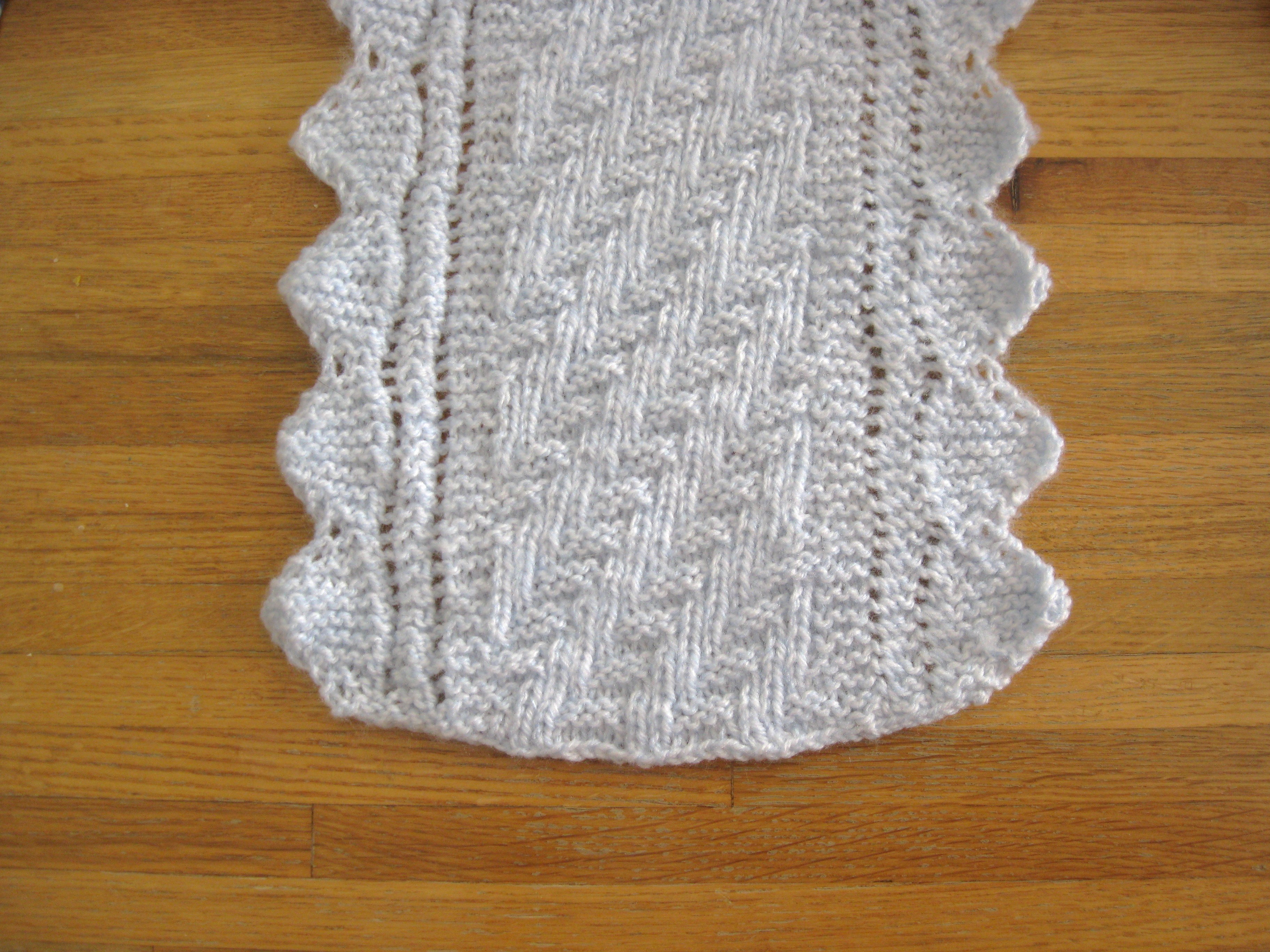
Shells & Stairways: a Reversible Scarf with scalloped Edging

Photo by Rich Hill

Contributed by Donna W. Hill

On receiving a Braille copy of Barbara G. Walker’s A Second Treasury of Knitting Patterns (Schoolhouse Press, 1998) from National Library Services for the Blind (NLS) this winter, I headed straight to the last chapter — “Edgings.” These patterns, often under fifteen stitches wide, are generally made in long narrow strips and sown onto the bottoms of everything from fancy skirts and blouses to curtains and pillow cases.

OK, I hate to sew, but I love these little edging patterns. Nonetheless, unless you want them for headbands or belts, you’ve got to do more than just knit them as is. I started by incorporating several edgings into round table scarves using the short-row method, but I was looking for something else.

Walker came to my rescue. She suggests that some edgings can be seamlessly incorporated up the sides of things like afghans. The best edgings for this purpose are those that are reversible.

I wanted to make fancy scarves for the girls in our neighborhood, and I wanted them to be unique. I like scarves, but I’m not fond of fringes. They get caught on things and fray. What about using edgings as fancy vertical borders instead?

Knitting the Stairways

Photo by Rich Hill

The main pattern for this scarf is Rib and Welt Diagonals (2nd TKP, p. 9). I first encountered this pattern as Reversible Diagonal from Amy Carroll’s out-of-print Pattern Library Knitting (Ballantine Books 1981). I didn’t alter anything about it except the name, which (in both instances) makes it sound much plainer than it is. It’s not just diagonal stripes. It looks like a series of staircases with a bit of ribbing between them, which could be handrails. It is reversible, though the staircases slant in the opposite direction.

The stairways are made from two-row blocks of 5 stitches which are alternated between reverse stockinette (purlground) and stockinette stitch. They are flanked by 3 stitches of k1, p1 ribbing. The purlground blocks stick up to form the steps, and the stockinette blocks are recessed, forming the risers between them. The steps role a bit simulating the way real steps hang over their risers. The ribbing follows the steps and accents the diagonal line.

The 8 stitch figure shifts one stitch to the right every right-side row. Thus, the pattern requires 16 rows. Walker starts with “k1, p1, k1, p5.” Remember that although we read left to right; we knit right to left.

Rows 1, 3 and 5 shift from having all three ribbing stitches at the beginning of the right-side row, to having just two and then only one. Thus, the pattern shows stitches before the asterisk and the last repeat is incomplete. On row 7, the full five-stitch block (as stockinette) is at the beginning. The right-side rows throughout the rest of the 16-row pattern find the first block reduced from five stitches to four, three, two and one.

For a more thorough explanation of how purlground and stockinette patterns interact vertically and horizontally in this pattern, visit The Knitter’s Gazebo: Lessons from Shells & Stairways Scarf.

Knitting the Shell Edging

The Shell Edging, which runs the length of both sides of the scarf, is essentially identical on both right and wrong sides. It is a combination of two stitches from Walker’s Plain Scalloped Edging (2nd TKP, pp. 255-6) with 9 stitches of fagoting and a 3-stitch garter strip, which serves as the inner border.

Several things are happening. After the 3-stitch garter section, little bundles of stitches (made from yarn over ssk, k1 on one side and k2 p1 on the other) separate the stairway design from the scallops. Each side needs 11 stitches for this vertical border. My husband originally called the scallops “clam shells” and then said they resemble the beehive hairdos of the ’60s. I prefer thinking of them as shells.

The Plain Scallop pattern requires 16 rows — a perfect match-up with the stairway pattern. Shells are made in garter stitch by increasing eight stitches, one stitch every row — yes, every row. Those two stitches grow into ten. Decreasing is then done on every row. For a shallower scallop, try it on every other row.

Although this scarf is reversible, be sure to plug in the right-side row when knitting it. I call the odd-numbered rows the right side, and it is from that perspective that I refer to the right-hand and left-hand shells on the edges of the scarf.

Variations on the Scarf

For a wider scarf, add a multiple of 8 to the center. Make it wider still, and call it a stole. Add more garter stitches to the inside of the edging, or add multiples of three stitches for extra fagoting.

Shells & Stairways Scarf

This pattern incorporates Rib and Welt Diagonals with a shell edging based on Walker’s Plain Scalloped Edging (2nd TKP, p. 255) and a bit of fagoting. The stairways can be widened by multiples of eight stitches to form a stole or rectangular shawl.

Materials: 8 oz. Bernat Baby Sport yarn (Baby Denim), size 5 needles and 4 place markers. Substitute your favorite yarn and needles.

Cast on 46 stitches

Note: place markers after the first 11 stitches and before the last 11 stitches to separate the stairway pattern from the two edges. The other two go after the first 2 stitches and before the last 2; these define the increase/decrease sections for the shells along the edge, which go from 2 to 10 stitches.

Inc: increase 1 stitch — knit into front and back of next stitch.

Preparation Row (wrong side): k 35, (to last 11 sts), PM, k3, (yo, ssk, k1) twice, PM, inc, k1 (3 sts, begins first right-hand shell).

Row 1 (right side): k1, inc, k1, PM, (k2, p1) twice, k3, PM, *k1, p1, k1, p5; repeat to PM, k3, (yo, ssk, k1) twice, PM, inc, k1 (3 sts, begins first left-hand shell).
Row 2: k1, inc, k1, PM, (k2, p1) twice, k3, PM, *k5, p1, k1, p1; repeat to PM, k3, (yo, ssk, k1) twice, PM, k2, inc, k1.
Row 3: k1, inc, k3, PM, (k2, p1) twice, k3, PM k1, p1, *k5, p1, k1, p1; last repeat, k5, p1, PM, k3, (yo, ssk, k1) twice, PM, k2, inc, k1.
Row 4: k1, inc, k3, PM, (k2, p1) twice, k3, PM, k1, *p5, k1, p1, k1; end p5, k1, p1, PM, k3, (yo, ssk, k1) twice, PM, k4, inc, k1.
Row 5: k1, inc, k5, PM, (k2, p1) twice, k3, PM, k1, *p5, k1, p1, k1; end p5, k1, p1, PM, k3, (yo, ssk, k1) twice, PM, k4, inc, k1.
Row 6: k1, inc, k5, PM, (k2, p1) twice, k3, PM, k1, p1, *k5, p1, k1, p1; end k5, p1, PM, k3, (yo, ssk, k1) twice, PM, k6, inc, k1.
Row 7: k1, inc, k7 (10 sts, ends increase for right-hand shell), PM, (k2, p1) twice, k3, PM, *k5, p1, k1, p1; repeat to PM, k3, (yo, ssk, k1) twice, PM, k6, inc, k1.
Row 8: k1, inc, k7 (10 sts, ends increase for left-hand shell), PM, (k2, p1) twice, k3, PM, *k1, p1, k1, p5; repeat to PM, k3, (yo, ssk, k1) twice, PM, k7, k2 tog, k1 (9 sts, begins decrease for right-hand shell).
Row 9: k1, k2 tog, k6, PM, (k2, p1) twice, k3, PM, p4, *k1, p1, k1, p5; end (k1, p1) twice, PM, k3, (yo, ssk, k1) twice, PM, k7, k2 tog, k1 (9 sts, begins decrease for the left-hand shell).
Ro 10: k1, k2 tog, k6, PM, (k2, p1) twice, k3, PM, k1, *p1, k1, p1, k5; end p1, k1, p1, k4, PM, k3, (yo, ssk, k1) twice, PM, k5, k2 tog, k1.
Row 11, k1, k2 tog, k4, PM, (k2, p1) twice, k3, PM, k3, *p1, k1, p1, k5; end p1, k1, p1, k2, PM, k3, (yo, ssk, k1) twice, PM, k5, k2 tog, k1.
Row 12: k1, k2 tog, k4, PM, (k2, p1) twice, k3, PM, p2, *k1, p1, k1, p5; end k1, p1, k1, p3, PM, k3, (yo, ssk, k1) twice, PM, k3, k2 tog, k1.
Row 13: k1, k2 tog, k2, PM, (k2, p1) twice, k3, PM, p2, *k1, p1, k1, p5; end k1, p1, k1, p3, PM, k3, (yo, ssk, k1) twice, PM, k3, k2 tog, k1.
Row 14: k1, k2 tog, k2, PM, (k2, p1) twice, k3, PM, k3, *p1, k1, p1, k5; end p1, k1, p1, k2, PM, k3, (yo, ssk, k1) twice, PM, k1, k2 tog, k1.
Row 15: k1, k2 tog (ends decrease for right-hand shell), PM, (k2, p1) twice, k3, PM, k1, *p1, k1, p1, k5; end p1, k1, p1, k4, PM, k3, (yo, ssk, k1) twice, PM, k1, k2 tog, k1.
Row 16: k1, k2 tog, (2 sts, ends decrease for left-hand shell), PM, p4, *k1, p1, k1, p5; end (k1, p1) twice, PM, k3, (yo, ssk, k1) twice, PM, inc, k1 (3 sts, begins increase for next right-hand shell).

Repeat Rows 1-16 to desired length. On final Row 16, knit the last 11 stitches. Bind off.

Previous Older Entries Next Newer Entries