The Simple or Half Hitch Cast On

Probably the easiest cast on is the method called the simple or half hitch cast on. It produces a row of loose stitches and works up so quickly that it’s my preferred method for swatches and other obscenities. If you know the long-tail cast on, the half hitch is the first part of that, and no long tail is needed.

Here’s how it’s done:

Note: these instructions assume you’re right-handed.

1. Tie a slip knot around the needle, and hold the needle in your right hand. For this cast on, there is only one needle, and it is always in your right hand.
2. Position your left hand as if you were holding a glass of water. The thumb and index finger form an open circle, and the side of your hand (your pinky) is what would rest on the table if one were in front of you.
3. Lay the yarn over your thumb and index finger. The ball end goes over your index finger. The tail goes over your thumb. The needle is pointing left and resting on the side of your hand, roughly where the thumb and index finger meet.
4. Curl the middle, ring, and pinky fingers of your left hand into the palm, tucking the two hanging strands of yarn into them. When you do, the yarn in your left hand forms a down-pointing triangle. There’s a horizontal line between your thumb and index finger, a diagonal line from index to middle finger, and another diagonal line from thumb to middle finger. The needle is on top of the horizontal line, resting both on the yarn and on the side of your left hand. Use the curled fingers to put a little tension on the yarn as you work the remaining steps.
5. Rotate the needle so that it is pointing at you. It passes over the horizontal line, so the triangle is still fairly in tact.
6. Bring the tip of the needle down, stopping when it touches the fleshy part of your palm at the base of your thumb. The needle is between you and the yarn.
7. Slide the tip of the needle up your thumb, stopping when the tip of the needle is on the tip of your thumb. The needle tip has slid behind the leg of the triangle that goes from thumb to middle finger. By the time the tip of the needle reaches the tip of the thumb, it is inside a loop that surrounds the thumb.
8. Pull your thumb out of the loop, and in the same movement, use your thumb to catch and tug on the yarn that is between the needle and your middle finger. The gesture is like opening a pair of scissors to cut. This tug tightens the loop on the needle.
9. Move the needle back to the starting position, on top of the horizontal line of the inverted triangle, and repeat Steps 5 to 8.
10. Knit across the cast-on stitches.

Step 10 is important. The cast-on stitches themselves are so loose that they don’t really keep their shape when you divide them over several needles or even drop them in a bag to return to later, so working the first row, preferably with knit stitches firms them up.

I often use this cast on when I need to add stitches to the middle or end of a row because the point where the cast on meets the rest of the work is tidier than with other methods.

Another plus is that this cast on can easily become a provisional cast on (a topic to be covered in detail later). In a nutshell, after Step 9, you would run a second needle between the stitches that have been cast on and leave it there until it’s time to knit from that needle.

With this cast on in your bag of tricks, you have a simple and serviceable method for starting ordinary work and a secret weapon for doing more complex knitting.

Knitting Pattern Central

I’m very excited to share with everyone that my Be Mine Hat pattern has been listed on Knitting Pattern Central.

Now, honestly, this isn’t a very big accomplishment in the grander scheme of things. The only requirements for listing your pattern are that it be free and have a picture. But, as an amateur pattern designer, I think it’s awesome.

All I had to do was fill out the contact form. I included links for the blog post and the PDF download. She chose to list the blog link which is actually better than just the download.

Knitting Pattern Central is a great website. The owner has compiled a lot, probably thousands, of free patterns. They are all organized by type. You’ll find mine under “Hats”. If you haven’t ever checked it out, please do. The website I mean, not my pattern, but you can check that out too. There is also Crochet Pattern Central for crocheters so don’t worry if you don’t knit.

Hopefully, I’ll share more patterns soon and, if you’ve written your own pattern, spruce it up and share it with the world.

All About The Kitchener Stitch

the Kitchener stitch was supposedly made popular during WWII by Lord Kitchener of England. He was looking for a better way to graft the toes of socks for his soldiers (they kept getting holes in them) so he promoted the Red Cross knitting program which included a pattern for socks with grafted toes. All though this is a very nice story, you should know there isn’t really any proof that this is where the name comes from. Regardless of the history of the Kitchener stitch, it has become a standard way to seam two knitted pieces of fabric.

For myself, I’ve found the Kitchener stitch to be a great way to seam. I’ve mostly used it for the toes of socks but it can also be used to close the bottom of a bag or the top of a hat. You do not want to use this seam anywhere you want extra stability in the fabric such as shoulders. Yu should still use something like a three needle bind off for these. This seaming technique uses two rows of live stitches and creates a seamless join also known as grafting.

A lot of people get really nervous when it comes to the Kitchener stitch. You shouldn’t be. It has simple steps and can be easily mastered with a little practice. Before you know it, you’ll be able to Kitchener without looking at the directions. Have a little faith and try it the next time you want a seamless join.

Grafting Stockinette Fabric with Kitchener Stitch


You can practice by knitting two stockinette swatches and stopping before you bind off. Leave the swatches on the needles and hold the two swatches together with the purl sides facing each other. You will be adding another row of knit stitches with the tapestry needle to join the fabric seamlessly.

Anytime you want to Kitchener, you will need to start with two rows of live stitches. For simplicities sake, each row must have the same number of stitches. The purl sides of the work should be facing the inside. Your yarn should be coming from the last stitch on the right of the back needle and be at least 3 times longer than the seam you are about to graft. You will work all the stitches from right to left. Thread the tail onto a tapestry needle and you’re ready to begin.

Now, the set up involves two steps. You will only do each of these once.

  1. Run your tapestry needle through the first stitch on the front needle as if to purl and pull the yarn through.
  2. Run your tapestry needle through the first stitch on the back needle as if to knit and pull the yarn through.


Now, you can get down to business. You will repeat these four steps until all the stitches are grafted.

  1. Put your tapestry needle through the first stitch on the front as if to knit and slide the stitch from the knitting needle to the tapestry needle. Do not pull the yarn through.
  2. Run your tapestry needle into the next stitch on the front as if to purl and pull the yarn through. Do not slide the stitch off the needle.
  3. Put your tapestry needle into the first stitch on the back needle as if to purl and slip the stitch from the knitting needle to the tapestry needle. Do not pull the yarn through.
  4. Run your tapestry needle through the next stitch on the back needle as if to knit and pull the yarn through. Do not slip the stitch off the knitting needle.


It helps to chant knit purl, purl knit as you go to help keep track of where you are. ‘With a little practice, Kitchener stitch becomes second nature. Try not to make your stitches too tight or too loose. You want your finished tension to match the tension of your work. Just like everything else, this gets easier with time and practice.

Grafting Garter Fabric with Kitchener Stitch


You can also graft garter fabric seamlessly with the Kitchener stitch. If you have been working garter in the round, you need to end with a knit row. Your last row of purl bumps need to be facing each other. If you hold the needles as if you are about to Kitchener, the last row of bumps will be behind the front needle and in front of the back needle so they will touch when held together.

The basic preparation is the same as for grafting stockinette. You need the same number of stitches on each needle and a tail of yarn three times longer than the seam coming from the back needle on the right. When working the Kitchener stitch for garter fabric you will be creating a row of purl stitches that will become the last garter ridge needed to join the fabric seamlessly.

Your set up steps will be a little different. Do each of these only once.

  1. Run your tapestry needle through the first stitch on the front needle as if to purl and pull the yarn through.
  2. Run your tapestry needle through the first stitch on the back needle as if to purl and pull the yarn through.


There will only be two actual steps to repeat to Kitchener garter fabric but here are all 4 steps written out. You are repeating the same two steps on each needle.

  1. Put your tapestry needle through the first stitch on the front as if to knit and slide the stitch from the knitting needle to the tapestry needle.
  2. Run your tapestry needle into the next stitch on the front as if to purl and pull the yarn through. Do not slide the stitch off the needle.
  3. Put your tapestry needle through the first stitch on the back as if to knit and slide the stitch from the knitting needle to the tapestry needle.
  4. Run your tapestry needle into the next stitch on the back as if to purl and pull the yarn through. Do not slide the stitch off the needle.


For this the chant would be knit purl, knit purl.

Good luck using the Kitchener stitch. If you’re nervous, be sure to practice before trying it on your finished work. You’ll be making seamless joins in no time.

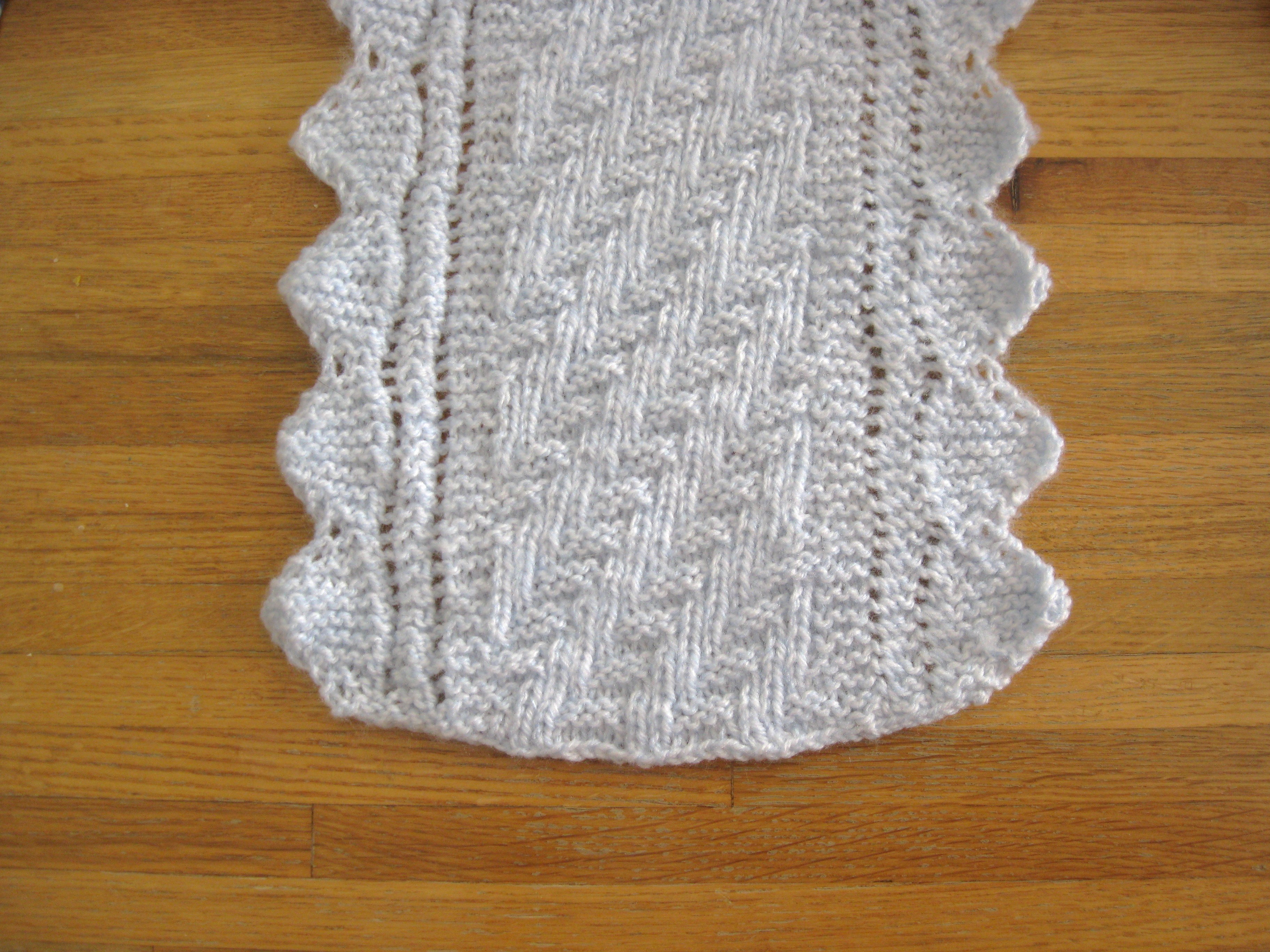
Shells & Stairways: a Reversible Scarf with scalloped Edging

Photo by Rich Hill

Contributed by Donna W. Hill

On receiving a Braille copy of Barbara G. Walker’s A Second Treasury of Knitting Patterns (Schoolhouse Press, 1998) from National Library Services for the Blind (NLS) this winter, I headed straight to the last chapter — “Edgings.” These patterns, often under fifteen stitches wide, are generally made in long narrow strips and sown onto the bottoms of everything from fancy skirts and blouses to curtains and pillow cases.

OK, I hate to sew, but I love these little edging patterns. Nonetheless, unless you want them for headbands or belts, you’ve got to do more than just knit them as is. I started by incorporating several edgings into round table scarves using the short-row method, but I was looking for something else.

Walker came to my rescue. She suggests that some edgings can be seamlessly incorporated up the sides of things like afghans. The best edgings for this purpose are those that are reversible.

I wanted to make fancy scarves for the girls in our neighborhood, and I wanted them to be unique. I like scarves, but I’m not fond of fringes. They get caught on things and fray. What about using edgings as fancy vertical borders instead?

Knitting the Stairways

Photo by Rich Hill

The main pattern for this scarf is Rib and Welt Diagonals (2nd TKP, p. 9). I first encountered this pattern as Reversible Diagonal from Amy Carroll’s out-of-print Pattern Library Knitting (Ballantine Books 1981). I didn’t alter anything about it except the name, which (in both instances) makes it sound much plainer than it is. It’s not just diagonal stripes. It looks like a series of staircases with a bit of ribbing between them, which could be handrails. It is reversible, though the staircases slant in the opposite direction.

The stairways are made from two-row blocks of 5 stitches which are alternated between reverse stockinette (purlground) and stockinette stitch. They are flanked by 3 stitches of k1, p1 ribbing. The purlground blocks stick up to form the steps, and the stockinette blocks are recessed, forming the risers between them. The steps role a bit simulating the way real steps hang over their risers. The ribbing follows the steps and accents the diagonal line.

The 8 stitch figure shifts one stitch to the right every right-side row. Thus, the pattern requires 16 rows. Walker starts with “k1, p1, k1, p5.” Remember that although we read left to right; we knit right to left.

Rows 1, 3 and 5 shift from having all three ribbing stitches at the beginning of the right-side row, to having just two and then only one. Thus, the pattern shows stitches before the asterisk and the last repeat is incomplete. On row 7, the full five-stitch block (as stockinette) is at the beginning. The right-side rows throughout the rest of the 16-row pattern find the first block reduced from five stitches to four, three, two and one.

For a more thorough explanation of how purlground and stockinette patterns interact vertically and horizontally in this pattern, visit The Knitter’s Gazebo: Lessons from Shells & Stairways Scarf.

Knitting the Shell Edging

The Shell Edging, which runs the length of both sides of the scarf, is essentially identical on both right and wrong sides. It is a combination of two stitches from Walker’s Plain Scalloped Edging (2nd TKP, pp. 255-6) with 9 stitches of fagoting and a 3-stitch garter strip, which serves as the inner border.

Several things are happening. After the 3-stitch garter section, little bundles of stitches (made from yarn over ssk, k1 on one side and k2 p1 on the other) separate the stairway design from the scallops. Each side needs 11 stitches for this vertical border. My husband originally called the scallops “clam shells” and then said they resemble the beehive hairdos of the ’60s. I prefer thinking of them as shells.

The Plain Scallop pattern requires 16 rows — a perfect match-up with the stairway pattern. Shells are made in garter stitch by increasing eight stitches, one stitch every row — yes, every row. Those two stitches grow into ten. Decreasing is then done on every row. For a shallower scallop, try it on every other row.

Although this scarf is reversible, be sure to plug in the right-side row when knitting it. I call the odd-numbered rows the right side, and it is from that perspective that I refer to the right-hand and left-hand shells on the edges of the scarf.

Variations on the Scarf

For a wider scarf, add a multiple of 8 to the center. Make it wider still, and call it a stole. Add more garter stitches to the inside of the edging, or add multiples of three stitches for extra fagoting.

Shells & Stairways Scarf

This pattern incorporates Rib and Welt Diagonals with a shell edging based on Walker’s Plain Scalloped Edging (2nd TKP, p. 255) and a bit of fagoting. The stairways can be widened by multiples of eight stitches to form a stole or rectangular shawl.

Materials: 8 oz. Bernat Baby Sport yarn (Baby Denim), size 5 needles and 4 place markers. Substitute your favorite yarn and needles.

Cast on 46 stitches

Note: place markers after the first 11 stitches and before the last 11 stitches to separate the stairway pattern from the two edges. The other two go after the first 2 stitches and before the last 2; these define the increase/decrease sections for the shells along the edge, which go from 2 to 10 stitches.

Inc: increase 1 stitch — knit into front and back of next stitch.

Preparation Row (wrong side): k 35, (to last 11 sts), PM, k3, (yo, ssk, k1) twice, PM, inc, k1 (3 sts, begins first right-hand shell).

Row 1 (right side): k1, inc, k1, PM, (k2, p1) twice, k3, PM, *k1, p1, k1, p5; repeat to PM, k3, (yo, ssk, k1) twice, PM, inc, k1 (3 sts, begins first left-hand shell).
Row 2: k1, inc, k1, PM, (k2, p1) twice, k3, PM, *k5, p1, k1, p1; repeat to PM, k3, (yo, ssk, k1) twice, PM, k2, inc, k1.
Row 3: k1, inc, k3, PM, (k2, p1) twice, k3, PM k1, p1, *k5, p1, k1, p1; last repeat, k5, p1, PM, k3, (yo, ssk, k1) twice, PM, k2, inc, k1.
Row 4: k1, inc, k3, PM, (k2, p1) twice, k3, PM, k1, *p5, k1, p1, k1; end p5, k1, p1, PM, k3, (yo, ssk, k1) twice, PM, k4, inc, k1.
Row 5: k1, inc, k5, PM, (k2, p1) twice, k3, PM, k1, *p5, k1, p1, k1; end p5, k1, p1, PM, k3, (yo, ssk, k1) twice, PM, k4, inc, k1.
Row 6: k1, inc, k5, PM, (k2, p1) twice, k3, PM, k1, p1, *k5, p1, k1, p1; end k5, p1, PM, k3, (yo, ssk, k1) twice, PM, k6, inc, k1.
Row 7: k1, inc, k7 (10 sts, ends increase for right-hand shell), PM, (k2, p1) twice, k3, PM, *k5, p1, k1, p1; repeat to PM, k3, (yo, ssk, k1) twice, PM, k6, inc, k1.
Row 8: k1, inc, k7 (10 sts, ends increase for left-hand shell), PM, (k2, p1) twice, k3, PM, *k1, p1, k1, p5; repeat to PM, k3, (yo, ssk, k1) twice, PM, k7, k2 tog, k1 (9 sts, begins decrease for right-hand shell).
Row 9: k1, k2 tog, k6, PM, (k2, p1) twice, k3, PM, p4, *k1, p1, k1, p5; end (k1, p1) twice, PM, k3, (yo, ssk, k1) twice, PM, k7, k2 tog, k1 (9 sts, begins decrease for the left-hand shell).
Ro 10: k1, k2 tog, k6, PM, (k2, p1) twice, k3, PM, k1, *p1, k1, p1, k5; end p1, k1, p1, k4, PM, k3, (yo, ssk, k1) twice, PM, k5, k2 tog, k1.
Row 11, k1, k2 tog, k4, PM, (k2, p1) twice, k3, PM, k3, *p1, k1, p1, k5; end p1, k1, p1, k2, PM, k3, (yo, ssk, k1) twice, PM, k5, k2 tog, k1.
Row 12: k1, k2 tog, k4, PM, (k2, p1) twice, k3, PM, p2, *k1, p1, k1, p5; end k1, p1, k1, p3, PM, k3, (yo, ssk, k1) twice, PM, k3, k2 tog, k1.
Row 13: k1, k2 tog, k2, PM, (k2, p1) twice, k3, PM, p2, *k1, p1, k1, p5; end k1, p1, k1, p3, PM, k3, (yo, ssk, k1) twice, PM, k3, k2 tog, k1.
Row 14: k1, k2 tog, k2, PM, (k2, p1) twice, k3, PM, k3, *p1, k1, p1, k5; end p1, k1, p1, k2, PM, k3, (yo, ssk, k1) twice, PM, k1, k2 tog, k1.
Row 15: k1, k2 tog (ends decrease for right-hand shell), PM, (k2, p1) twice, k3, PM, k1, *p1, k1, p1, k5; end p1, k1, p1, k4, PM, k3, (yo, ssk, k1) twice, PM, k1, k2 tog, k1.
Row 16: k1, k2 tog, (2 sts, ends decrease for left-hand shell), PM, p4, *k1, p1, k1, p5; end (k1, p1) twice, PM, k3, (yo, ssk, k1) twice, PM, inc, k1 (3 sts, begins increase for next right-hand shell).

Repeat Rows 1-16 to desired length. On final Row 16, knit the last 11 stitches. Bind off.

Cable Cast on

The cable cast on is another one of my favorite ways to begin a piece of knitting. It produces an attractive rope-like edge, so it’s nice for hats, socks, mittens, collars, and other projects that put the cast-on edge in a potentially prominent position.

This cast on involves both needles. The steps are almost identical to the knit-on cast on. The only difference is that, instead of inserting the right needle into the first stitch, you insert it between the first and second stitches.

Here’s how it’s done:

Notes:
• the first stitch is the one closest to the tip of the needle.
• These instructions assume you’re right handed.

Casting on Knit Stitches

1. Cast on 2 stitches using any cast on you like.
2. Hold the needle with the stitches in your left hand if it isn’t there already. The left needle points to the right or possibly up.
3. Insert the tip of the right needle between the first and second stitches on the left hand. The right needle goes in from front to back. It slides under the left, and the needles are roughly perpendicular to each other, forming a cross or an X.
4. Wrap the working yarn around the right needle. For English knitters, the yarn is wrapped counterclockwise. For continental knitters, the right needle tip starts behind the working yarn and scoops it as the needle moves toward you in the next step. In both cases, the yarn is in the back of the work.
5. Slide the right needle toward you and out of the loop. to keep the working yarn from falling off the needle, place the tip of the right needle on the shaft of the left, and smoothly slide the right needle tip down the length toward the thick base or cable. (Is anyone else getting warm?)
6. Once the new stitch is on the right needle and once the right needle is in front of the left, hold the needles perpendicular to each other, forming a cross or an X. Both needles are pointing up, and they intersect at the stitch.
7. Move your right hand to the right, stopping when the tips of the two needles are touching each other. To be clear, the needles form a bridge or inverted V. The left one is on the left, and the right one is on the right. The new stitch is still on the right needle, stretching from between the first two stitches on the left.
8. Slip the new stitch from the right needle to the left, and tug on the working yarn to tighten.
9. Repeat Steps 3-8 for each additional stitch.

This version of the cast on makes a knit row because everything except Step 3 is what you normally do for a knit stitch.

If you want to cast on purl stitches,, like for ribbing, the process is the same except that you insert the right needle from behind the work and wrap as for a purl stitch.

Casting on Purl Stitches

1. Cast on 2 stitches using any cast on you like.
2. Hold the needle with the stitches in your left hand if it isn’t there already. The left needle points to the right or possibly up.
3. Insert the tip of the right needle between the first and second stitches on the left hand. The right needle goes in from back to front. It slides under the left, and the needles are roughly perpendicular to each other, forming a cross or an X.
4. Wrap the working yarn around the right needle. For English knitters, the yarn is wrapped counterclockwise. For continental knitters, the working yarn is in front of the right needle and goes over the top and down behind the needle. In both cases, the yarn is in the back of the work.
5. Slide the right needle away from you and out of the loop. to keep the working yarn from falling off the needle, place the tip of the right needle on the shaft of the left, and smoothly slide the right needle tip up the length toward the tip of the left. (Is anyone else getting warm?)
6. Once the new stitch is on the right needle and once the right needle is behind the left, hold the needles perpendicular to each other, forming a cross or an X. Both needles are pointing up, and they intersect at the stitch.
7. Move your right hand to the right, stopping when the tips of the two needles are touching each other. To be clear, the needles form a bridge or inverted V. The left one is on the left, and the right one is on the right. The new stitch is still on the right needle, stretching from between the first two stitches on the left.
8. Slip the new stitch from the right needle to the left, and tug on the working yarn to tighten.
9. Repeat Steps 3-8 for each additional stitch.

There you have it: a decorative cast on that is easy to learn. Try it on your next project, especially if the cast-on edge is something other people might notice.

Review: APH Score Card as Row Counter

Many blind and low-vision knitters have a problem finding a good way to keep track of what row they are on.  One device I’ve found useful to count rows is the score card from APH.

These score cards are about 3” by 10” and very thin so they will go into most project bags easily. There are two rows of ten buttons each that can be used to count up to 110. I use the top row for tens and the bottom row for ones. The cards are made of thin plastic with a cardboard backing. They can be bent if you, for example, sit on one. However, they are very brightly colored so they would be easy for a low-vision person to see.

As for durability, I would say that, with care, they would last for a very long time. Now, if you compulsively press and un-press the buttons while talking on the phone, the plastic will break down and you’ll have holes where your buttons should be.

I like using one of these as a row counter. They are easy to lay on the table or couch and mark each row with just the press of a button. This can be done one handed so there is minimal interruption to your knitting or crocheting.

I would recommend these to anyone looking for a convenient way to count rows without a lot of hassle. You can find these score cards at APH and they are two for $15.

APH Score Cards

For other row counting ideas see Ana’s post, Asking Stitchers and Counting Rows

Ravelry Tutorial: Joining A Group

Ravelry has a very large network of online groups and forums. There are groups for everything you can imagine. I’m in a group for people who like the Wheel Of Time fantasy series and another for people who hate charts. There is also a group for blind and low vision knitters. I don’t post to the groups very often but they can be very helpful.

Finding And Joining A Group


  1. Go to Ravelry and log in if you aren’t already.
  2. Go to the top of the page and arrow down to find the “Groups” link.
  3. This page will list the groups you are in. You can search for a group as well as browse. Searching will probably be faster. The search field can be found under the “Search Groups” heading. It’s also the only form field on the page so you can easily find it with your screen reader’s find next form field command.
  4. Let’s search for the group for blind and low vision knitters. Type “Blind” in the search box and press enter.
  5. Use your screen reader’s find next text command to find the words Search Results for blind”. Then arrow down to view your search results. I got 13 results in my search including one very funny one at the end of the list. The biggest group for blind knitters is called “Blind Webs”, and it is the first result.
  6. Press enter on the group you want to join or learn more about.


This will take you to the group’s main page and you can explore to find out more about the group. There is a search edit box after the fresh discussion threads if you want to search the groups or forums.

The quickest way to find the “Join This Group” link is to use your screen reader’s links list. You can also find it a few links down from the search edit box.

Posting To A Group


On the individual group pages there will be a heading called “Fresh Discussion Threads”. Below this heading you will find a link to post a new topic as well as a link to subscribe to the group. This subscribe link takes you to the RSS feed and, if you want, you can get a message when there is a new topic in the group.

Below these links there is a table with the latest discussion threads. Press enter on any of the titles and it will take you to the thread. You can also subscribe to the individual threads from their specific pages.

To post to the thread just press enter on the reply link after any post to answer that comment specifically or use the “Reply To Thread” link at the bottom of the page for a more general response.

To quickly get to a list of your groups just press enter on the “Groups” link at the top of the page. The first heading will tell how many groups you are in; just arrow down to read the list. Have fun checking out all the different groups in Ravelry. There’s one for just about everything and if you can’t find the group you want, you can start one.

Long-Tail Cast On

My favorite way to start a piece of knitting is the long-tail cast on. It produces a row of stitches on a nice sturdy base, which is both attractive and firm enough to keep its shape while I divide the work onto other needles. It’s one of those techniques that is easy and fluid once you get the hang of it, but hard to learn from books and online sources because the explanation is tough going. So … here’s one more attempt at putting the long tail cast on into words:

Some clarification:
A. These instructions assume you’re right handed.
B. This is called the “long tail cast on” because you need to start with a tail of yarn that is long enough to work all of your stitches, but not so long that yarn is being wasted or getting in the way when you’re ready to start knitting. Calculating the length of the tail is an art. The short, get-the-job-done version is to make the tail about 3.25 times the length of the first row, so if the first row is supposed to be 10 inches long, the tail should be about 32.5 inches. This is a little on the generous side, but it’s easier to weave and snip than to have to start over when the yarn runs out. For this example, use a tail that is 1 ft or 30 cm long. This means the slip knot in Step 1 is a foot or 30 cm from the end.
C. Once you feel comfortable with this cast on, you can get started simply by twisting the yarn around the needle instead of making a slip knot.

1. Tie a slip knot around the needle, and hold the needle in your right hand. For this cast on, there is only one needle, and it is always in your right hand.
2. Position your left hand as if you were holding a glass of water. The thumb and index finger form an open circle, and the side of your hand (your pinky) is what would rest on a table if one were in front of you.
3. Lay the yarn over your thumb and index finger. The ball end goes over your index finger. The tail goes over your thumb. The needle is pointing left and resting on the side of your hand, roughly where the thumb and index finger meet.
4. Curl the middle, ring, and pinky fingers of your left hand into the palm, tucking the two hanging strands of yarn into them. When you do, the yarn in your left hand forms a down-pointing triangle. There’s a horizontal line between your thumb and index finger, a diagonal line from index to middle finger, and another diagonal line from thumb to middle finger. The needle is on top of the horizontal line, resting both on the yarn and on the side of your left hand. Use the curled fingers to put a little tension on the yarn as you work the remaining steps.
5. Rotate the needle so that it is pointing at you. It passes over the horizontal line, so the triangle is still fairly in tact.
6. Bring the tip of the needle down, stopping when it touches the fleshy part of your palm at the base of your thumb. The needle is between you and the yarn
7. Slide the tip of the needle up your thumb, stopping when the tip of the needle is on the tip of your thumb. The needle tip has slid behind the leg of the triangle that goes from thumb to middle finger. By the time the tip of the needle reaches the tip of the thumb, it is inside a loop that surrounds the thumb.
8. Describe a circle with the tip of the needle, moving it away from you and over the strand that is between the needle and your index finger, then down behind that strand, then toward you and under that strand, then back to the tip of your thumb.
9. Slide the tip of the needle down your thumb and back into the big loop of yarn surrounding it, stopping when the needle tip reaches the first bend in your thumb.
10. Pull your thumb out of the big loop, and in the same movement, use your thumb to catch and tug on the yarn that is between the needle and your middle finger. The gesture is like opening a pair of scissors to cut. This tug tightens the loop on the needle.
11. Move the needle back to the starting position, on top of the horizontal line of the inverted triangle, and repeat Steps 5 to 11.

As the cast-on becomes familiar, it softens into a series of curves, the needle tip arcing down and up, the thumb bending forward and stretching back, until the movements stop being separate and merge into one graceful sweep.

Thanks Honey!

The other day I was feeding the baby when my husband, Brian, came in and asked, “Do you still have that pattern?” I have no idea what he’s talking about, of course. At first I thought he wanted me to make him something but it turned out to be the other way around. He wanted the woodworking plans for a tabletop yarn swift. I’m thinking it’s been years since I asked for one but I’m not about to say anything now. Come to think of it, I have been mentioning lately that I have a lot of skeins of yarn waiting to be spun up. I’m sure Brian is picturing having to hold the skeins of yarn with his arms straight out while I spin endless balls of yarn with my ball winder.

So we dig up the plans and he goes to the hardware store. The materials cost under $5. Basically some wood, a bolt and a wing nut. The swift consists of two main pieces with a small block of wood in between so it will spin easier. The top piece is a large cross with peg holes drilled in the arms. There are dowel rods that you move to keep the skein of yarn snug.

We tested it this evening. With the addition of a couple washers and some waxing to reduce friction, it works wonderfully. I don’t know if it works as well as a commercial yarn swift but I’m sure the difference, if any, isn’t much.

Here’s the pattern he used. He did make a few changes but they are all minor.

So Easy Portable Tabletop Yarn Swift

Ravelry Tutorial: Searching For A Pattern

Ravelry is a great place to search for patterns. The most helpful part is selecting different search parameters. In this tutorial we’ll go through a sample search. We’ll search for a sweater pattern that uses worsted weight yarn, uses between 900 and 1200 yards, is for a child aged 4 to 12 and is available for free.

  1. Go to Ravelry and log in if you aren’t already.
  2. Go to the top of the page and arrow down to find the “Patterns” link. Press enter.
  3. This will take you to the pattern search page. You can also browse for patterns but today we’re going to search. Type “sweater” in the search field and press enter.
  4. This will bring up your preliminary results. Navigate to the first heading. It will read “Search.” Now use your screen reader’s find next text command once. It should land on the number of search results. I got 22,884 so we definitely need to narrow it down a little.
  5. Arrow down until you find the drop box with the words “Jump to filter.” Below this box is a list of all the different search options. They are all the same as what is listed in the drop box. When you select a filter from the drop box it will move that set of options to the top of the list. You will have to go back to the drop box each time you need to select another filter because when you press enter or tab out of the box your cursor moves to the bottom of the filter you chose. The drop box will be the first form field from the top of the page so it’s not hard to find.
  6.  Select “Weight” from the drop box and press tab to exit the box. You can arrow up through the choices or go back to the drop box and arrow down to get them in the right order. Either way, press enter on “Worsted 10-Ply”. The numbers after the choices tell how many matching patterns Ravelry has for this filter.
  7. Now select “Yardage” from the drop down box. If you have any trouble finding where you are after you tab out of the box, just remember that the drop box is the first form field from the top of the page, and the filter you just chose is immediately after it. Now press enter on “900-1200 yards”.
  8. Go back to the drop box and Select “Gender/Age/Size/Fit”. This filter requires you to select a sub-filter before you can make your choice. Press enter on “Age or Size”. Then press enter on “Child (4–12)”. You can press escape to close the sub-filter options if you are going to be arrowing around a lot but it’s not necessary.
  9. Now find the drop box for the last time and select “Availability”. Either arrow up to find “Free” or go back to the drop box and arrow down. Press enter on “Free”.
  10. Now that your search has been narrowed down you can get your results. After selecting the last filter, your cursor should be at the top of the search results. If you arrow down, you will find a list of the filters you chose followed by your search results. If you get lost on the page go to the top and use your screen reader’s find next text command to find the words “Search Results for Sweater” and arrow down from there.


Keep in mind that you can select as many or as few search parameters as you like. Also, pressing enter on the pattern name will take you to the Ravelry pattern page. This page has a lot of information about the pattern that can include yardage, available sizes. Gauge and suggested yarn. You will also find a link to the pattern source.

After the pattern details you will find the following links: Cast On, Add to Faves, To Queue. Selecting “Cast On” Will add this pattern as a new project in your notebook. Select this if you want to start the project right away. “Add to Faves” adds this pattern to a list of things you like. “To Queue” adds the pattern to a list of patterns you want to do in the future.

Have fun looking through the patterns. I’ll be back soon with another Ravelry tutorial.

Previous Older Entries Next Newer Entries